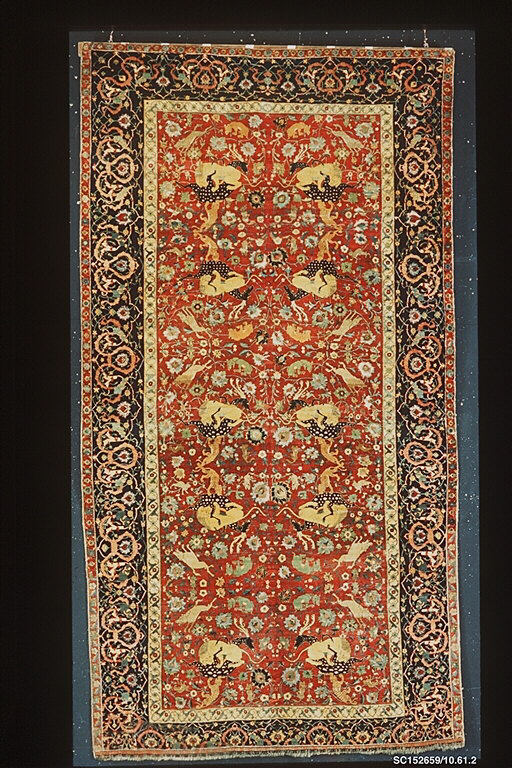
Floor coverings have been in use throughout the ages, whether they are flat woven or have a pile weave. Both forms were in use in Persia, but the focus here is on the knotted pile carpets. These carpets can be made of silk, wool, or cotton and can be made on either a vertical or horizontal loom.
The Design
The most familiar design of a Persian rug is composed of a medallion in the center and borders surrounding that center. Both the medallions and the borders can have geometric, floral, or even human and animal figures. An extant persian carpet, shown below, housed at the Metropolitan Museum of Art (accession #10.61.2) shows many such designs. This carpet has multiple borders around the edges of the carpet, but the center is composed of a repeated pattern of lions attacking multiple other animals.

The Loom
The loom is made of two horizontal bars and two vertical bars. The Warp is wrapped around the vertical bars as seen in the figure below. A shed stick is passed under every other warp string. Heddles are then wrapped around the warp threads that are under the shed stick and attached to the heddle rod. The combination of the shed stick and the heddles allow a space, called a shed, to be formed. This shed is where the weft threads will be passed through to make the base of the carpet.

The knots
The knots that form the pile of the carpet can be tied a couple of different ways. There is the Turkish symmetrical double knot, labeled as (a) in the figure below, and there is the Persian asymmetrical single knot, labeled as (b) and (c) in the figure below. Each knot is formed by taking the cut end of the pile thread and tying it around two warp threads. Once the knot is tied, the pile thread is cut away from the pile thread source.
 https://iranicaonline.org/articles/carpets-iii#prettyPhoto
The Weaving
The heddle is adjusted from the neutral position to form a shed. The weft thread is put through the shed of the warp. The heddle is adjusted to form the opposite shed and the weft thread is passed through again. The heddle is then adjusted to the neutral position and a row of knots is tied. After an entire row of knots are tied, the weft thread is again put through the two sheds of the warp. After a few rows of the knots are tied, the pile thread can be trimmed to an even length.
Finishing
After all the knots have been added, the top edge of the carpet is then finished with multiple rows of flat weaving. The side edges are then finished by overcasting the two outermost warp threads down the length of the carpet. The carpet is then cut off the loom and the loose warp threads are then tied and may be turned into fringe.
Putting it all together
The process of making the carpet includes warping, weaving and finishing the edges. The warp is tied onto the loom as described in the loom section. The weaving can then be started with multiple passes of the weft thread through the shed at the base of the loom to secure the bottom edge of the carpet. After the bottom edge is secured, a row of knots will be tied onto the warp threads, leaving the two outermost warp threads empty. Between each row of knots, the weft thread is passed through the shed two times to secure the knots. The pile threads are then trimmed again to an even length. The carpet can then be cut from the loom and the finishing steps can be completed. The sides are then bound the ends fringed or bound and the carpet is finished.
Resources:
https://metmuseum.org/art/collection/search/445995?pos=18&rpp=20&pg=1&ft=Fabric&when=A.D.+1400-1600
http://www.iranicaonline.org/articles/carpets-iii
Also here are more resources that I need to investigate more.
Dimand, Maurice S., and Jean Mailey. Oriental Rugs in the Metropolitan Museum of Art. New York: The Metropolitan Museum of Art, 1973. no. 11, pp. 52, 100, ill. fig. 75 (b/w).
Stanzer, W. 1993. Kordi: Leben, Knüpfen, Weben der Kurden Khorasans = Lives, rugs, flatweaves of the Kurds in Khorasan. Wien: Adil Besim OHG im Eigenverlag
Eagleton, William. 1988. An introduction to Kurdish rugs and other weavings. Buckhurst Hill: Scorpion.
Flury-Lemberg, Mechthild. 1988. Textile conservation and research a documentation of the textile department on the occasion of the twentieth anniversary of the Abegg Foundation. Bern: Abegg-Stiftung Bern.
PINNER, Robert, and Walter B. DENNY. 1986. Oriental carpet and textile studies. London: HALI.
*Ittig, Annette. 2007. “Glossary of technical and structural terminology”. Iranian Studies. 25 (1-2): 141-146
*Hardin, Ian R., and Frances J. Duffield. 2007. “Microanalysis of Persian textiles”. Iranian Studies. 25 (1-2): 43-59
*Annette Ittig. 1992. “Notes on a Zīlū Fragment Dated 963/1556 in the Islamic Museum, Cairo”. Iranian Studies. 25 (1-2): 37-42.
*Afshar, Iraj. 2007. “Zilū”. Iranian Studies. 25 (1-2): 31-36.
*Kawami, Trudy S. 2007. “Archaeological evidence for textiles in pre‐Islamic Iran”. Iranian Studies. 25 (1-2): 7-18.
*Require further reading and checking bibliography
 Arts and Studies